

Have you noticed how much the crypto trading market has changed in recent years? Traders now have more ways to profit from price movements, and perpetual futures have become a popular option.
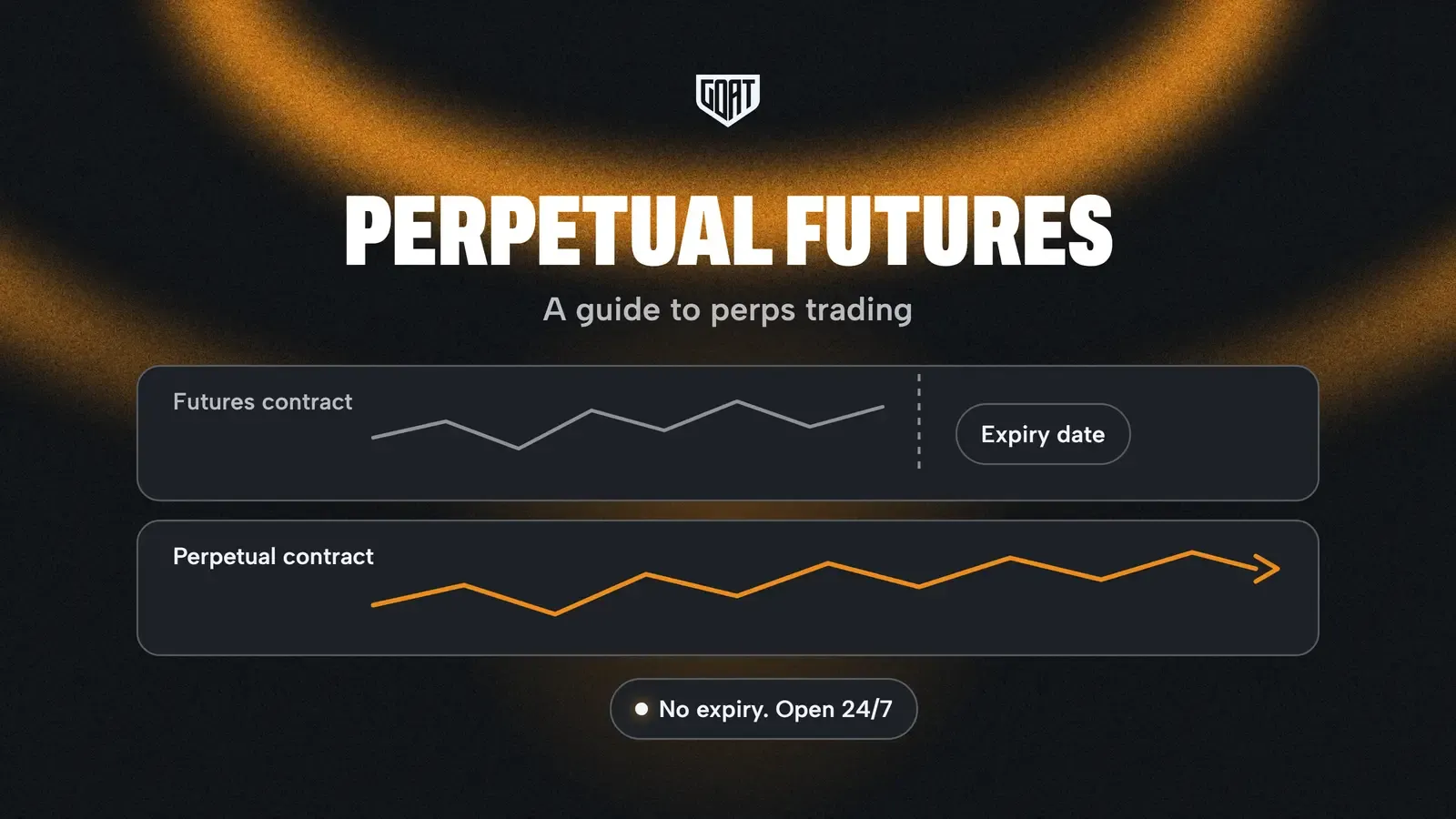
Unlike traditional futures, these contracts have no expiry date, so you can keep a position open as long as you meet the required margin and funding conditions. You can also go long or short and use leverage to increase your market exposure.
But how do perps futures work, what makes them different from older contracts, and what risks should you know? Let's break down the basics and see how a perps prop firm fits into this growing market.
How Perps Contracts Work
Let's start with the basics. A perpetual contract is a derivative, which means its value follows an underlying asset such as Bitcoin or Ethereum without you owning the asset itself.
You post margin, choose a direction, and open the trade. From there, the position stays open until you close it, or until the exchange closes it for you through liquidation.
So why did this product take off? Perps futures first appeared on crypto exchanges, and the structure fit digital assets perfectly.
In 2016, BitMEX launched the first widely used perp. The idea goes back to a proposal from economist Robert Shiller in the early 1990s. Cryptocurrency markets run 24 hours a day, 7 days a week, and they never close for the weekend.
A contract with no expiry date suits this kind of nonstop trading. iShares, citing CoinGecko data, reports that centralized exchanges traded about $86 trillion in perps in 2025, while decentralized venues traded nearly $6.7 trillion.
Today, the idea has spread beyond Bitcoin. Several platforms now list perps on equities, commodities, and indices, so you can reach a wider menu of markets from one account.
The appeal comes down to flexibility. You can go long when you expect a price to rise, or short when you expect it to fall, and both directions use the same tools.
How Perps Differ From Traditional Futures Contracts
So how do perps differ from the older contracts you may already know? The biggest difference is the calendar.
Traditional futures contracts agree on a price for a future settlement date. When the date arrives, the contract expires.
- If you want to keep your exposure, you must close the position and roll into a later contract month, paying costs and managing the timing yourself.
- As expiry approaches, the contract price also converges with the spot price, which is the live market price of the asset.
Perps remove the expiry, so you can hold a position as long as your margin supports it. This creates a new problem to solve.
With no expiry to pull the contract price back toward spot, the market needs another way to keep the two aligned. The funding rate does this job, and the next section explains how.
Below is a quick comparison of the practical differences for you as a trader:
- Expiry: Traditional contracts settle on a fixed date, while perps have none.
- Rollover: Traditional positions need rolling into a new month, while perps do not.
- Price anchor: Traditional contracts converge at expiry, while perps use periodic funding payments.
- Holding period: You can hold a perp for as long as you keep enough margin.
The Funding Rate Mechanism
The funding rate mechanism is the heart of every perp.
At regular intervals, traders on one side of the market pay traders on the other side. Payment moves between traders, and the exchange does not collect it as a fee. Researchers at EPFL and Wharton describe these periodic payments as the link that ties the contract price to the spot price.
Here is how it works in practice:
- When the perp trades above the spot price, the funding rate turns positive and long traders pay short traders. Holding a long position becomes more expensive, which discourages buying and nudges the perp price back down.
- When the perp trades below spot, the rate turns negative and short traders pay longs, which encourages buying and lifts the price.
How frequently does this happen? It depends on the venue. Some platforms settle funding every 8 hours, while others settle every hour. Hyperliquid, for example, pays funding every hour, as its documentation explains.
If you hold a leveraged position through several intervals, funding adds up, so you should include it in your trade plan like any other cost. Below is an example: if you hold a $10,000 long position and the funding rate is 0.01% for that period, you pay $1 to the short traders, and you pay again at each new interval.
Funding also works as a sentiment gauge. A persistently high positive rate tells you the market is crowded with long traders, which can raise the risk of a sharp reversal.
Index and Mark Price
Perpetual contracts use two key price references to track market value, calculate profits and losses, and manage liquidation risk: the index and the mark price.
Index price
It shows the average spot price of an asset across several exchanges. Prices from each exchange are combined based on their share of the total, giving the platform a wider view of the market. It is also used in funding calculations to measure how far the perp contract price has moved from the wider spot market.
Mark price
This is designed to calculate unrealized profit and loss and determine when a position reaches its liquidation level. It combines fair value data with adjustments based on perp market activity. This helps filter out sudden price spikes caused by low liquidity, reducing the risk of liquidation from brief market swings.
Together, these two price references help you monitor liquidation risk and see how closely the contract price follows the wider market. The mark and index price also give you a clearer picture of current market conditions.
Leverage, Margin and Liquidation
Now for leverage, which makes perps exciting and risky in equal measure. Margin is the collateral you post to open a position, and leverage multiplies your buying power.
With 10x leverage, you control a position 10 times the size of your margin. The same multiplier applies to losses, so a move of around 10% against you can erase your margin.
- National regulators in the EU found that 74-89% of retail CFD accounts typically lose money, a reminder of how fast leverage can hurt.
This is why perps futures demand careful position sizing. When your equity falls below the maintenance margin, the platform liquidates the position automatically.
Many platforms also offer two margin modes:
- Isolated margin limits the risk to the margin you set aside for one position
- Cross margin shares your whole balance across all positions, which can delay liquidation but puts more of your balance at risk.
Traders who use lower leverage give their positions more room to survive normal volatility, and a stop loss placed before you enter the trade protects you from decisions made under pressure.
Benefits and Risks of Perps Trading
With the mechanics clear, let's weigh what you gain and what you risk. Each benefit below comes with a matching responsibility.
Benefits
- No expiry or rollover: You hold a position without managing contract months.
- Deep liquidity on major pairs: Tight spreads make entries and exits easier.
- Long and short exposure: You can trade rising and falling markets with the same tools.
- Capital efficiency: Margin lets you open larger positions with less capital.
Risks
- Liquidation: Leveraged moves can close your position quickly.
- Funding costs: Holding costs build up when you keep a position open for long periods.
- Volatility: Sharp swings in cryptocurrency markets can reach your stop loss in minutes.
- Platform exposure: You rely on the venue's execution and risk systems.
Trading Perps With a Prop Firm
Trading perps with your own capital puts the full downside on you. This is where a perps prop firm comes in.
You pay a one-time evaluation fee, show your skill by hitting the profit target without breaking the rules, and move to a funded account where you keep a share of the profits. Your risk stays limited to the fee.
Funded accounts at these firms run on simulated capital, so rewards follow your trading performance and not deposits in live markets.
Trade Perps With Goat Funded Perpetuals
Ready to put this knowledge to work? Goat Funded has entered the perpetuals market with Goat Funded Perpetuals, a brand built for traders who love perps and want a seamless way to trade them.
You get a clear path from evaluation to payout, backed by the same focus on trader experience Goat Funded is known for.
The foundation is already proven. Across our group, we have paid out over $33M in rewards to traders. The wider Goat Funded community includes 1.1M+ traders across 182+ countries, with a 4.8 rating from 5K+ verified buyers.
Goat Funded Perpetuals brings this reputation to perps futures, so you can trade with a team traders already know.
Here is what this means for you:
- Brand built for perps lovers: Your trading experience is designed around perpetual markets.
- Proven track record: Over $33M has been paid out across Goat Funded Trader and Goat Funded Futures.
- Global trader community: 1.1M+ traders across 182+ countries, with support through the help centre and Discord.
- Simple route to payout: Move from evaluation to a simulated funded account to rewards with clear rules at every step.
Visit Goat Funded Perpetuals and start your perps journey today.