

In traditional markets, trading often slows down when Friday night arrives. Perpetual futures, also known as perps, are different. Prices keep moving throughout the weekend, and traders around the world can continue opening and closing positions.
Currently, more traders can now access them through prop firms, which provide simulated trading accounts.
You do not risk your personal savings, but your trading results still determine your eligibility for real rewards. That makes having a sound strategy important.
Which approach should you use? This guide breaks down the main perps prop trading strategies, explaining how each works, when to use it, and how to manage risk while trading.
Know the Basics First
Before you pick a plan, you need to know three parts of a perp trade:
- No end date: You can hold a trade as long as your margin, the money you set aside for it, allows.
- Leverage: You control a bigger trade with less money, which makes both profit and loss bigger.
- Funding rate: Traders on one side pay traders on the other side every hour or every few hours, depending on the venue, to keep the perp price close to the real price.
Each strategy below uses these parts differently. Keep them in mind as you read.
Why Perps Suit Active Traders
Perps trade day and night, including weekends, so you can trade when it suits your life. You can also go long or short.
Going long means you gain when the price rises, and going short means you gain when the price falls. Both give you a plan for both up and down markets. Perps are also where the volume is, as Cboe research puts 2025 crypto derivatives volume at about 4.4 times spot turnover.
Six Strategies You Can Use
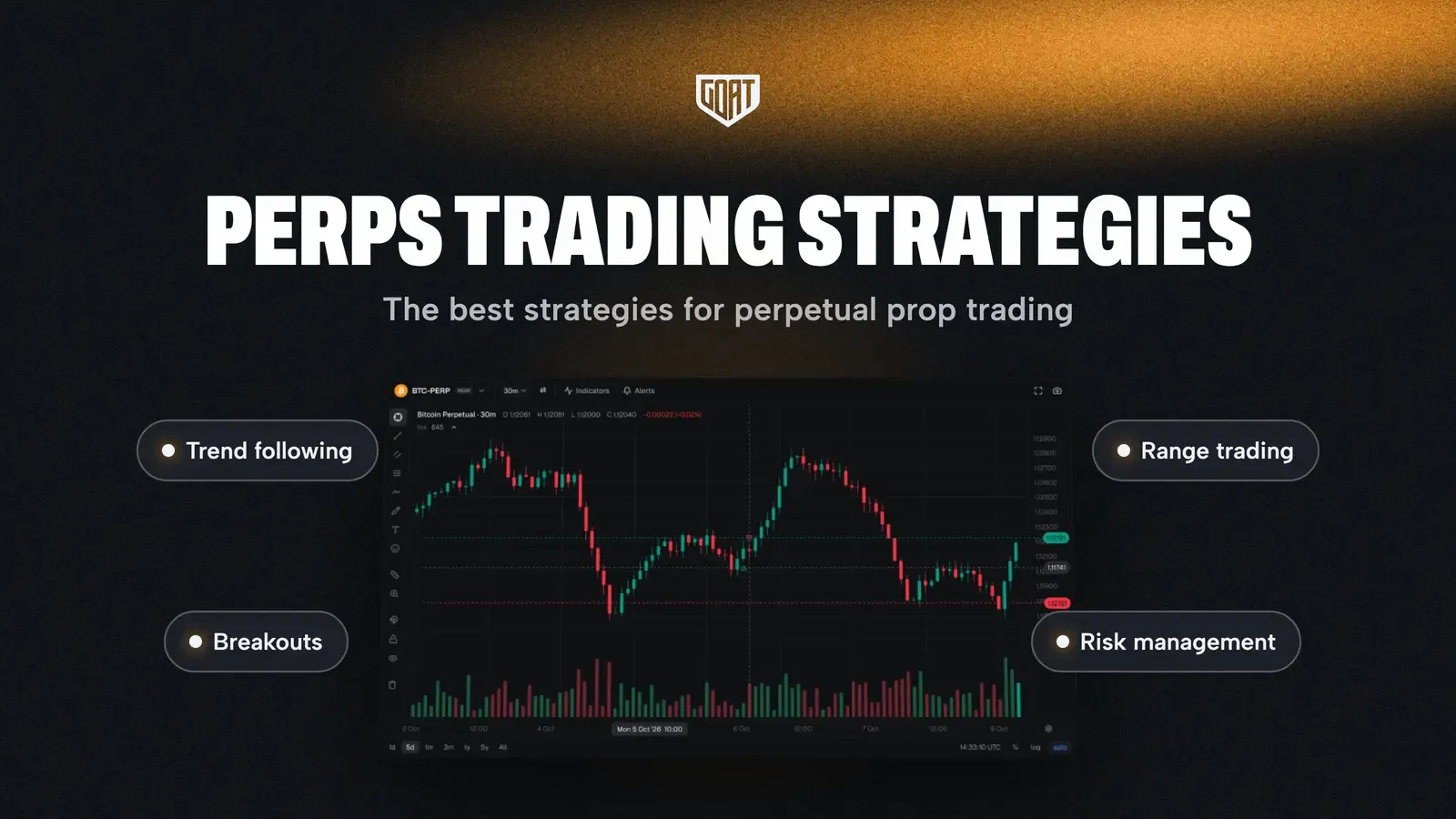
Below are six perps prop trading strategies traders use every day:
1) Trend Following
Trend following means you trade in the same direction as the market. If price makes higher highs and higher lows, you look for buys.
If it makes lower highs and lower lows, you look for sells. Many traders use a moving average to see the trend. It is a line which shows the average price over a set time, and when price sits above it, the trend is up.
A good entry is a small pullback to the line. You wait for price to dip, then join the trend. Do not chase a big move which has already run.
This plan works well when the market moves in one clear direction, and badly when price goes sideways.
In perps prop trading, a trend trade can stay open for hours, so make sure your stop sits well inside your daily loss limit, and remember that funding keeps adding up while you hold.
2) Range Trading
Some markets move up and down between two price levels. The top level is called resistance, and the bottom level is called support. In range trading, you buy near support and sell near resistance.
You place your stop loss, an order which closes the trade at a set price, just outside the range. This way, a break does not hurt you much. Range trading is calm and simple, but when price breaks out of the range, the plan stops working, so be ready to step aside.
In perps prop trading, a range that fails can hit your stop several times in one day, and those small losses add up against your daily drawdown limit. Many traders stop for the day after two stop-outs.
3) Breakout Trading
A breakout happens when price moves past a key level with strength. You enter in the direction of the break and hope the move keeps going.
Fake breakouts are common. Price pokes above a level, then falls back. To stay safe, wait for price to close past the level on your chart, or wait for it to come back and test the level.
Check the volume too. Volume shows how much trading is going on, and a strong breakout comes with a rise in volume. In perps prop trading, a run of fake breakouts at high leverage can quickly use up your loss limit, so cut your size until the move proves itself.
4) Funding Rate Strategy
Funding is special to perps, and smart traders use it as a clue. When the funding rate is very high and positive, many traders are long.
The market is crowded, and a sharp fall can follow. Some traders look for short trades in this case, or they take profit on their longs.
When the funding rate is very low and negative, many traders are short, and a quick rise can follow. Funding also costs money when you hold a trade for many hours, so add it to your plan. On Hyperliquid, funding is paid every hour, so the cost builds up fast. In perps prop trading, check how your firm treats funding in its rules, because it can reduce your balance while a trade is open and leave you less room before the drawdown limit.
5) Scalping
Scalping means taking many short trades for small gains. A trade may last a few minutes or less. Scalpers need fast entries, tight stop losses, and a calm mind.
Trading costs add up fast, so each trade must be worth its cost. The SEC warns that day traders typically lose heavily in their first months, so test this style on a simulated account first. In perps prop trading, scalpers must watch daily drawdown limits, trading fees, and trading restrictions, as frequent losses can quickly breach account rules. This style suits traders who can watch the screen for long periods. If you have a busy day, it may not suit you.
6) Swing Trading
Swing trading means holding a trade for hours or days to catch a bigger move. You check the chart a few times a day, not every minute.
As you hold for longer, funding costs matter more. Use wider stops and smaller size, so a normal swing does not knock you out. This style suits traders with a job or a busy day.
In perps prop trading, a swing trade held overnight or over the weekend keeps paying funding, and a sharp move while you sleep can hit your maximum loss limit, so read your firm's rules on holding trades before you plan one.
Tools to Help You Trade These Plans
You do not need many tools. A price chart shows you the trend, the range, and the key levels. A moving average helps you see the direction of the trend, and volume shows how strong a move really is. Funding rate data shows which side of the market is crowded, and open interest, the number of contracts still open, shows how many positions are in play. Add one tool at a time, and keep only the ones you use.
Perpetual Prop Trading Risk Management Comes First
A good strategy still fails without good risk control. Think of risk control as the brakes on a fast car. CME Group's risk course says the key to trading success is managing risk and avoiding overtrading.
Strong perpetual prop trading risk management protects your simulated account, and it keeps you in the game for the long run. Here are the habits to build:
- Size your trades: Risk only a small, fixed part of your account on each trade, such as 1%. CME Group calls one popular version the 2% rule.
- Use a stop loss: Decide where you are wrong before you enter the trade.
- Keep leverage low: High leverage makes small moves hurt a lot, and it brings liquidation closer. If your platform offers isolated margin, it limits the loss on one trade to the margin you set aside for it.
- Know when to stop: Choose your own loss for the day, and stop trading when you reach it.
- Write a trade journal: Note why you entered, how you felt, and what happened.
A Quick Example:
Say you trade a simulated account of $10,000 and risk 1% on each trade. Below is an example:
- Account size: $10,000 simulated.
- Risk per trade: 1% is $100.
- Ten losses in a row: This would cost $1,000.
This hurts, but you can still recover. If you risked 10% per trade, three bad trades would hurt much more.
How to Choose Your Strategy
No plan fits every trader. Pick one that matches your time, your mood, and your goals. If you are short on time, swing trading needs fewer chart checks.
- If you love fast action, scalping gives many trades, but it needs focus.
- If you like calm markets, range trading fits quiet days. If you want a clear direction, trend following fits strong moves.
Start with one plan, and trade it on a simulated account until you know it well. Master one of these perps prop trading strategies before you try another.
Build a Simple Daily Routine
Strong traders follow a routine, as it can help you apply perps prop trading strategies the same way every day.
Before you trade, check the news, the funding rate, and your key price levels. While you trade, take only the trades matching your plan. After you trade, review each one in your journal.
Common Mistakes to Avoid
These are ways a handful of traders lose progress:
- Overtrading: Taking too many trades when you feel bored.
- Chasing losses: Raising your size to win back a loss.
- Ignoring funding: Holding a trade for days without checking the cost.
- Changing plans too fast: Switching strategy after two bad trades.
- Moving your stop loss: Pushing it further away when price turns against you.
Remember, these mistakes are a result of emotions and not your skill. So, always prioritize good perpetual prop trading risk management skills like writing down plans and progress. This enables you to stay steady when a trade goes wrong.
Put Your Strategy to Work on Goat Funded Perpetuals
With these perps prop trading strategies in hand, the next step is a place to practise them.
Goat Funded has entered the perps market with Goat Funded Perpetuals, a brand built for traders who love perps. Here is what you get:
- Trade day and night: Perps run 24/7, including weekends.
- 100+ markets: Trade crypto, stocks, commodities, and more, with prices from Hyperliquid.
- A full trading terminal: Charts, an order book, an order ticket, and an account health view help you plan and track each trade.
- Trade on the go: An iOS and Android app lets you follow your account and stats.
All accounts trade simulated perpetual contracts, so you can practise your plans without risking your own savings.
Get started today and put your plan to the test on Goat Funded Perpetuals.